


Common Mistakes to Avoid on Your Self-Assessment Tax Return: A Stress-Free Checklist

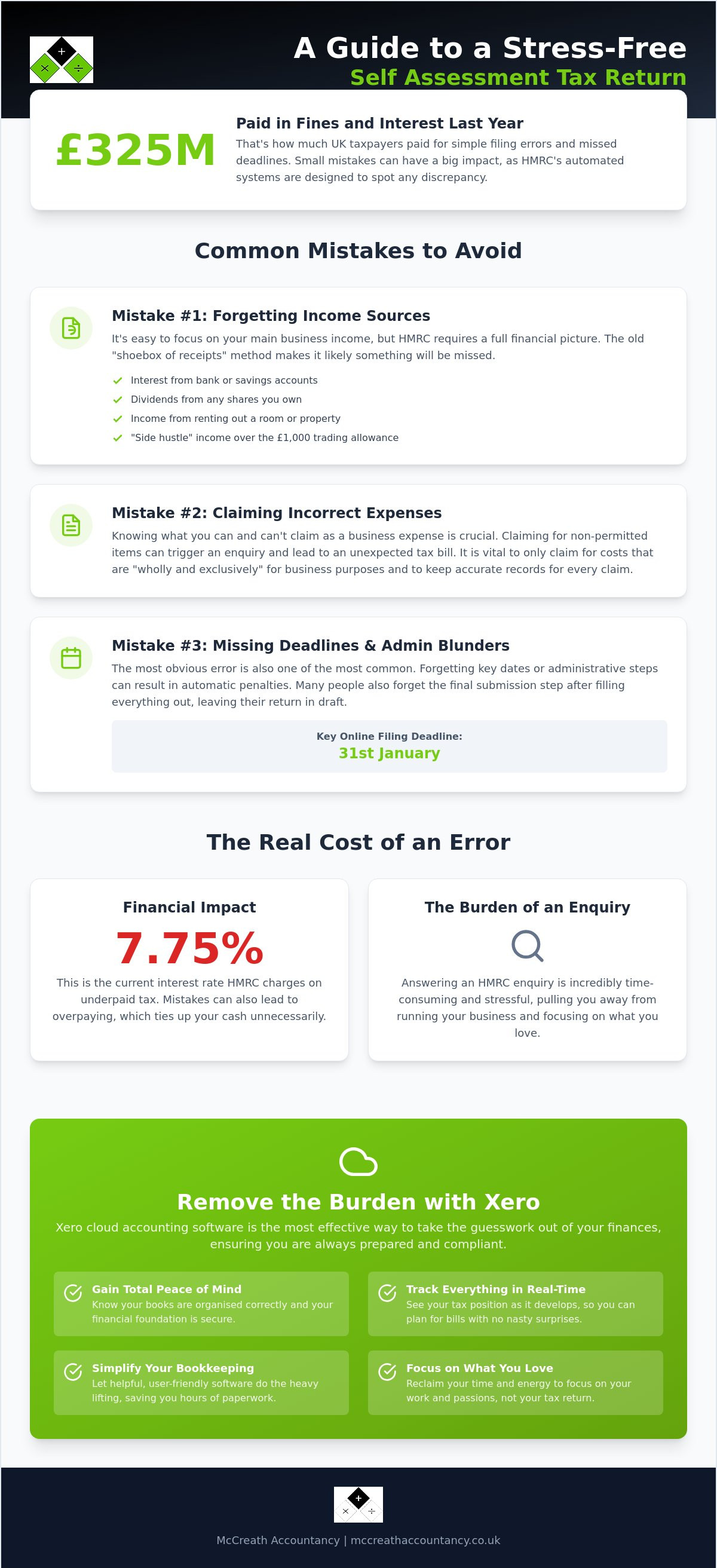
Did you know that UK taxpayers handed over £325 million in fines and interest last year simply for missing deadlines or making filing errors? It is a staggering figure that highlights how easily the pressure of paperwork can lead to costly slips. If you are currently feeling overwhelmed by a mountain of receipts, you certainly aren't alone in searching for the most common mistakes to avoid on self assessment tax return forms to protect your hard-earned money.
It's perfectly natural to feel a sense of dread as the HMRC deadline approaches, especially when you are unsure which business expenses are allowed or how to organise your records properly. You deserve to focus on your actual work and your passions, rather than being weighed down by the fear of a surprise tax bill. We find that the most effective way to remove this burden is by adopting Xero cloud accounting software. This helpful, user-friendly tool takes the guesswork out of your finances, allowing you to track everything in real time so you are always prepared and compliant.
In this article, we'll share a straightforward checklist to help you sidestep frequent filing errors and reclaim your time. You will discover how to gain total peace of mind and ensure your return is filed correctly and confidently well before the 31 January deadline.
Table of Contents
Why Small Errors on Your Self-Assessment Tax Return Matter
Errors on a tax return are often far simpler than many people imagine. They aren't always the result of complex financial schemes or deliberate deception; more often, they are the product of a misplaced digit, a forgotten savings account, or a misunderstanding of what qualifies as a business cost. HMRC uses sophisticated automated systems to cross-reference data from banks, employers, and other government departments. These systems are designed to flag patterns or discrepancies that don't quite add up, which means even a small, honest slip can trigger a notification. Understanding the specific mistakes to avoid on self assessment tax return filings is about more than just avoiding a letter from the tax office. It is about protecting your mental energy and ensuring your business remains on a stable footing.
When you consider the millions of UK tax returns processed every year, it's clear why technology plays such a central role in modern tax collection. Whilst these automated checks are efficient for the government, they can feel incredibly intrusive for a small business owner. By taking a proactive approach and organising your records through a platform like Xero cloud accounting software, you can align your data perfectly before it ever reaches HMRC. This level of precision allows you to reclaim your peace of mind, knowing that you've submitted a clear and accurate reflection of your hard work.
The Financial Impact of Inaccurate Filing
The consequences of a mistake are rarely just administrative. If an error leads to you underpaying your tax, HMRC will apply interest charges on the outstanding balance, which currently stands at 7.75%. On the other hand, overpaying your tax is equally damaging, as it unnecessarily ties up cash that could be used to grow your business or support your family. Inaccurate filings can also cause lengthy delays if you are owed a refund, leaving you waiting for money that should already be in your bank account. Using Xero helps you see your tax position in real time, so you can plan for your bills without any nasty surprises.
The Burden of an HMRC Enquiry
Even if an "unintentional" error doesn't lead to a fine, the process of answering an HMRC enquiry is incredibly time-consuming. It requires you to dig through old receipts and justify your figures, which pulls your focus away from your actual work. We act as a professional buffer in these situations, taking the heavy lifting off your shoulders so you don't have to deal with the tax office directly. There is a profound sense of freedom that comes from knowing your books are organised correctly. It allows you to breathe easier and focus entirely on your core passions, confident that your financial foundation is secure.
Mistake #1: Forgetting Income Sources and Poor Record-Keeping
Many people assume that their income only consists of the main invoices they send to clients. Whilst your primary business earnings are the core of your return, HMRC expects to see a complete picture of your financial life. This is one of the most frequent mistakes to avoid on self assessment tax return forms. It's incredibly easy to overlook smaller sums that arrive throughout the year, such as interest from your savings accounts, dividends from shares, or even rental income if you let out a room. When these details are missing, it creates a discrepancy that automated systems can easily flag, leading to unnecessary stress.
The "shoebox of receipts" approach is another major risk factor that often leads to these omissions. Relying on physical paper or manual notes makes it almost certain that something will be missed or lost. We often see how this lack of organisation creates a heavy emotional burden as the deadline nears. Investing time in professional accounts preparation for small business Scotland ensures that every stream of income is captured accurately. This structured approach allows you to step back from the paperwork and feel confident that your records are robust and reliable.
The "Side Hustle" Trap
If you earn extra money by selling items on platforms like eBay or Vinted, you might be part of the growing "side hustle" economy. There is a £1,000 trading allowance that allows you to earn a small amount of extra cash without paying tax. However, if your sales go above this limit and you are trading as a business, you must report this income. Even if the amounts feel small, they are still part of your total earnings. If you ever find you have made an error, the process for correcting your tax return is available, but getting it right from the start is much simpler.
Why Xero is the Secret to Accurate Records
Xero cloud accounting software is the most effective tool for ending the era of manual spreadsheets and paper piles. It connects directly to your bank account, automatically pulling in every transaction so you can see exactly where your money is going. This means you can view your profit in real time rather than guessing based on your bank balance. By using Xero, you transfer the heavy lifting of data entry to a smart system, leaving you with more time to focus on your actual work. If you would like to see how this could work for you, our team at McCreath Accountancy can help you get set up and reclaim your peace of mind.
Mistake #2: Claiming the Wrong Expenses or Missing Allowances
Claiming for costs that aren't strictly for work is one of the most common mistakes to avoid on self assessment tax return forms. HMRC follows a simple rule: a cost must be for your business only. In plain language, if you buy something that you also use for your personal life, you generally can't claim the full amount as a business expense. For example, a gym membership might help you stay healthy, but since it isn't essential for your specific job, it is usually considered a personal cost. Similarly, everyday lunches or the smart suit you wear to the office are common traps because they serve a dual purpose, regardless of how professional they make you feel.
Over-claiming these items can act as a red flag for automated systems. It suggests that your records might not be as meticulous as they should be, which can lead to unwanted questions and investigations. This is where seeking accountancy Glasgow services becomes a strategic advantage. We help you identify what is genuinely allowed, ensuring you stay on the right side of the rules whilst keeping your tax bill as low as possible. By having a professional eye on your figures, you can breathe easier knowing your claims are robust.
Home Office and Travel Costs
Calculating how much it costs to work from home doesn't have to be a struggle. You can either use a flat rate based on the hours you work or calculate a portion of your actual household bills. However, travel is often where people slip up. You can't claim for your daily commute to a regular place of work; only travel to temporary sites or client meetings counts. If you use your personal car, keeping a simple log of your business miles is essential. Xero makes this process much smoother by allowing you to categorise expenses as you go, so you are never left guessing at the end of the year. It replaces the stress of manual logs with a clear, digital trail.
Don’t Leave Money on the Table
Whilst avoiding over-claiming is vital, you also don't want to miss out on legitimate savings. Many people forget to claim for professional subscriptions or memberships to trade bodies that are necessary for their work. There is also the Marriage Allowance, which allows you to transfer a portion of your personal tax-free allowance to your spouse if they earn more than you. This can reduce your overall tax bill significantly. A professional review of your return often pays for itself by finding these hidden savings. It is about more than just numbers; it is about the peace of mind that comes from knowing you have claimed everything you are entitled to without overstepping the mark.
Mistake #3: Missing Deadlines and Administrative Blunders
Even if your figures are meticulous and your records are perfectly organised, timing can still be your undoing. One of the most frustrating mistakes to avoid on self assessment tax return submissions is simply missing the clock. HMRC is strict about its schedule, and failing to meet a deadline often results in an automatic £100 penalty, even if you don't actually owe any tax. The key dates are the 5th October for registering if you are new to self-employment, and the 31st January for both filing your return online and paying what you owe. Leaving everything until the final week of January is a common pitfall that creates unnecessary pressure and increases the chance of making a silly administrative error.
A surprisingly frequent blunder is the "Submit" button error. Many people spend hours carefully entering their data into the HMRC portal, save their progress, and then mistakenly believe they have finished. Saving is not the same as filing. You must follow the process through to the final confirmation screen to receive your submission receipt. Without that receipt, your return is technically outstanding. We also see many cases where incorrect National Insurance numbers or Unique Taxpayer References (UTRs) are entered, which can lead to payments being misallocated or returns being rejected. If you want to ensure your submission is handled with precision, you can book our professional tax return service to take that weight off your mind.
The Registration Hurdle
If this is your first year filing, you must register by 5th October. It is vital to understand that "registering" is just the first step; it isn't the same as actually filing your return. Getting your UTR number through the post can take several weeks, so you cannot leave this until January. If you have lost your login details for the government portal, don't panic. You can request a reset, but again, this takes time to process. Starting early is the best way to reclaim your peace of mind and avoid a last-minute scramble.
Payment Errors and "Payments on Account"
First-time filers are often caught out by "Payments on Account." If your tax bill is over £1,000, HMRC usually asks for half of next year's estimated tax upfront. This can effectively double your first bill, which is a significant shock if you haven't budgeted for it. Xero cloud accounting software is an excellent tool for avoiding this January surprise. By tracking your income and expenses throughout the year, Xero gives you a clear view of your mounting tax bill in real time. This allows you to set aside the correct amount every month, ensuring that when the deadline arrives, you have the funds ready and the correct payment reference to hand.
How Professional Support and Xero Remove the Tax Burden
At McCreath Accountancy, we believe that your time is your most precious asset. Managing a business is demanding enough without the added weight of complex tax regulations hanging over your head. By stepping in as your trusted guide, we take the heavy lifting of tax returns off your shoulders. This partnership allows you to breathe easier and focus on your core passions whilst we ensure every detail is handled with precision. It's a common misconception that professional support is an added cost; in reality, our fees often pay for themselves through the legitimate tax savings and allowances we identify. We don't just see this as a transaction; we see it as an ongoing conversation about your business health and a way to ensure you steer clear of the mistakes to avoid on self assessment tax return forms.
Our approach is built on the idea that financial clarity leads to peace of mind. When you work with us, you aren't just getting a service; you are gaining a dependable partner dedicated to your stability. We understand the fear that HMRC penalties can cause, and our goal is to act as a stabilizing force that removes that burden entirely. By transferring the responsibility of compliance to experts who care, you can reclaim your evenings and weekends, confident that your financial foundation is secure and meticulous.
Xero: Your Financial Centre
Xero cloud accounting software acts as the central hub for this organised approach. We help you move away from the stress of manual entry by setting up a system that provides "anywhere, anytime" access to your financial health. Whether you are at your desk in Glasgow or on a site in Renfrewshire, you can see your real-time profit and tax position with just a few clicks. This transparency means we can provide strategic tax advice throughout the year, rather than just reacting to figures in January. It transforms your bookkeeping from a chore into a powerful tool for growth, ensuring you are always prepared for the future.
Personalised Care from Linwood to Stornoway
Our roots are firmly planted in the communities we serve, from our base in Linwood to our connections in Stornoway and across the Western Isles. We understand the specific challenges and opportunities facing Scottish small businesses, and we pride ourselves on providing a personal touch that larger, national firms often lack. Whether you are a sole trader just starting out or an established business owner looking to reclaim your time, we are here to support you. Dealing with HMRC shouldn't be a source of dread. With the right technology and a dependable partner by your side, you can regain your focus, secure your financial freedom, and move forward with total confidence.
Reclaim Your Time and Peace of Mind
Filing your tax return shouldn't be a source of annual dread. By staying aware of the common mistakes to avoid on self assessment tax return forms, you've already begun to protect your business from unnecessary penalties and stress. Transitioning to a digital system like Xero doesn't just simplify your records; it provides the clarity you need to make confident decisions about your future.
We're here to act as your trusted guide, offering expert tax advice tailored specifically for Scottish sole traders. As certified Xero partners with local offices in Linwood and Stornoway, we pride ourselves on providing a personal touch that removes the burden of paperwork from your life. We take care of the details so you can focus entirely on your core passions and the work that truly matters to you.
Let us handle your Self-Assessment so you can focus on what you love. Get in touch with McCreath Accountancy today. You've worked hard to build your business, and you deserve to enjoy the rewards without the weight of HMRC deadlines holding you back.
Frequently Asked Questions
What happens if I realise I made a mistake after submitting my tax return?
You can usually amend your return within 12 months of the original filing deadline. This is done by logging back into the HMRC portal and correcting the specific figures that were entered incorrectly. If the change means you've paid too much tax, you can claim a refund, whilst an underpayment will require you to pay the difference plus any interest due.
Can I claim for my home broadband and mobile phone on my Self-Assessment?
You are allowed to claim for these costs, but only for the part that is used specifically for your business. If your mobile phone is used for both work and personal calls, you should calculate a fair percentage of the bill to include as an expense. Keeping a simple record of your usage helps ensure your claim is accurate and stands up to scrutiny.
How long do I need to keep my receipts and records for HMRC?
You must keep all your financial records for at least five years after the 31 January deadline of the relevant tax year. For example, records for the 2025/26 tax year should be kept until 31 January 2032. Digital tools like Xero make this much easier by allowing you to store electronic copies of your receipts securely in the cloud, removing the need for physical storage.
Do I need to file a tax return if I earned less than £1,000 from my side hustle?
You generally don't need to tell HMRC or pay tax if your total income from a side hustle is £1,000 or less before expenses. This is due to the Trading Allowance, which is designed to simplify tax for very small earners. However, if your turnover goes even a penny over this limit, you must register and file a return to stay compliant.
What is a UTR number and where can I find mine?
A Unique Taxpayer Reference (UTR) is a 10-digit number that identifies you personally within the tax system. You'll find it on any official letters from HMRC, such as your "Notice to File" or your statement of account. If you can't find your paperwork, it's also visible within your personal tax account on the government website once you have logged in.
Is Xero software difficult to set up for someone who isn’t tech-savvy?
Xero is built with simplicity in mind and is very easy to navigate, even if you don't consider yourself a "tech person." The platform uses everyday language rather than complex accounting terms, making it much more accessible than traditional spreadsheets. We offer a supportive setup process to ensure you feel confident using the software to manage your business health and reclaim your time.
How much are the penalties for filing a late Self-Assessment return in 2026?
Missing the online deadline for the 2025/26 tax year results in an immediate £100 penalty. If the return is still outstanding after three months, you'll face daily fines of £10, which can reach a maximum of £900. These costs are amongst the most important mistakes to avoid on self assessment tax return forms, especially since interest is also charged on any unpaid tax at a rate of 7.75% as of 2026.
Can an accountant help me if I have already missed the deadline?
Yes, we can help you resolve the situation quickly to prevent further penalties from building up. We'll work with you to organise your records, calculate your tax accurately, and submit the return as soon as possible to give you peace of mind. In some cases, we can also help you appeal a penalty if you had a reasonable excuse for the delay, such as a serious illness or a bereavement.



Comments